
Family health insurance premiums have climbed 24% over the past five years. Meanwhile, 67% of covered workers are now in self-funded arrangements. This is up from a fraction of that just a decade ago.
With that shift comes a new set of decisions. One of the most misunderstood is what happens at renewal when a stop-loss carrier flags a high-cost claimant, often called a laser.
Most employers hear the word “laser” and immediately push back. They ask their broker for a no-laser guarantee and feel relieved when they get one. The problem is that a no-laser policy doesn’t eliminate the cost of a high-risk individual. It hides it, and keeps charging you for it, sometimes long after the risk is gone.
What Is a Laser in Stop-Loss Insurance?
A stop-loss laser is a risk management tool, not a penalty. When a stop-loss carrier identifies an individual likely to generate exceptionally high claims, it can apply a higher specific deductible to that person rather than raising rates across the entire group.
For example, instead of covering that individual’s claims at the standard $100,000 deductible, deductible is set at $200,000. You carry more of the exposure for that specific person. Everyone else stays at the standard terms.
That’s it. A laser is a targeted adjustment to one person’s deductible. It’s not a denial of coverage, and it doesn’t affect the rest of your plan population.
What it is not: a punishment or a surprise. Lasers are disclosed at renewal. You know who is lasered, what their deductible is, and what your maximum exposure looks like.
Standard Specific Deductible vs Laser
| Standard Specific Deductible | With a Laser Applied | |
|---|---|---|
|
Who it applies to |
All plan members |
One identified high-cost individual |
|
Deductible amount |
$100,000 (example) |
$200,000+ (individual specific) |
|
Effect on rest of group |
Standard terms |
No change |
|
Premium impact |
Base rate |
Targeted – isolated to that individual |
|
Carrier exposure |
Full claims above $100K for everyone |
Full claims above laser amount for that person only |
A laser doesn’t change coverage for your workforce. It adjusts the deductible for one person and tells you exactly what your exposure is.
Why "No Laser" Isn't the Same as "No Cost"
Here’s what no-laser policies actually do: Carriers price the risk of that high-cost individual into the pool premium instead. The exposure doesn’t disappear; it gets embedded in what everyone in the group pays.
Carriers typically add a 7 to 10% premium load to no-laser contracts to protect against future laser risk. That load becomes your new baseline. Even if the high-cost individual leaves your plan six months into the year, you’re still paying a premium that was priced as if they’d be there all year.
The next renewal starts from that inflated baseline, too.
Roundstone’s internal data puts the average laser amount over specific deductible at $111,000. And here’s the figure that tends to surprise people: Only about one-third of lasered claimants actually reach their laser amount.
You read that right: Two out of three of claimants labeled high-risk will never reach that $100,000 laser amount.
Under a no-laser policy, you’d have paid a loaded premium for all of them anyway.
A Tale of Two Renewals
Let’s put some numbers to it. Consider a 300-life self-funded plan with a $100,000 specific deductible and $700,000 in annual stop-loss premiums. A new employee joins whose dependent requires ongoing specialty treatment with an expected annual cost of $350,000. At renewal, the employer receives two proposals.
(The figures below are illustrative. Your actual renewal scenarios will vary based on plan size, claims history, and carrier.)
Option one: A no-laser contract with a 30% rate increase. Total annual premium: $910,000. The employer carries no additional claimant-specific exposure, but pays $210,000 more per year than before. That inflated figure then becomes the new baseline for every renewal that follows.
Option two: A traditional laserable policy with an 8% increase. Base annual premium: $756,000. The carrier applies a $150,000 laser to the high-cost claimant. Worst-case total cost if that individual reaches the full laser amount is $906,000, roughly the same as option one in year one.
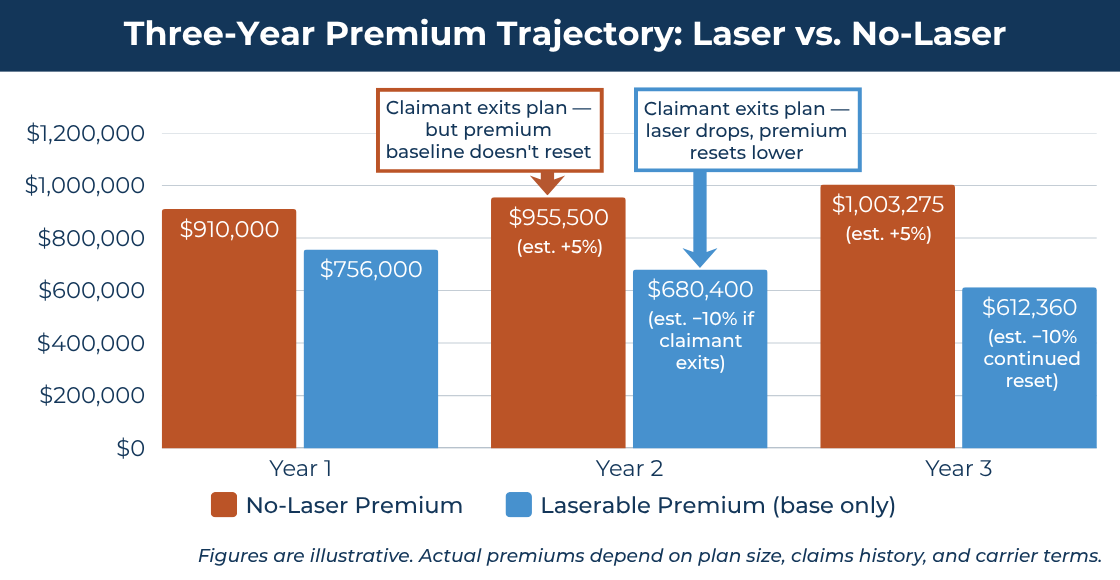
The critical difference is what happens in year two. Under the no-laser contract, the employer continues paying premiums priced for a risk that may no longer exist. Under the laserable policy, if the claimant’s condition resolves or they leave the plan, the laser drops and the premium baseline resets lower.
Budget certainty has real value, and for some employers the no-laser contract is the right call. The point isn’t that lasers are always better, but the choice deserves a full cost analysis, not a reflexive reaction to an unfamiliar term.
What the Actuarial Record Shows
Actuarial analyses bear this out. The records consistently show that large claims often have finite durations. High-cost claimants—those driving the claims that trigger stop-loss coverage—frequently resolve their exposure within a defined period.
Examples:
- A cancer patient completes treatment.
- A premature infant ages out of the NICU.
- A transplant patient stabilizes.
With a traditional laserable policy, cost impact is localized to the period when the risk is actually present. With a no-laser contract, high-cost claims get amortized into future renewals. Employers may continue paying for risks that no longer exist, with no corresponding benefit.
Questions to Ask Before Accepting a No-Laser Policy
Before you agree to no-laser terms at your next renewal, push for answers to these:
- What premium load is priced in? Ask the carrier to quantify the cost of the no-laser provision. If they won’t tell you, that’s information too.
- How long will this load stay in the premium? Find out whether the loaded rate resets if the high-cost individual leaves the plan or their condition resolves.
- What is the worst-case cost comparison? Run both scenarios: laser with maximum exposure vs. no-laser with the premium load. Compare total cost over two to three years.
- What cost management options exist for the lasered individual? In a captive, you can actively address the exposure. In a fully insured or pooled arrangement, you often can’t.
Is the no-laser guarantee worth the price in this specific case? For some employers, budget certainty matters more than cost optimization. That’s a legitimate choice, but make it with full information.
How the Captive Model Changes the Calculation
In a traditional self-funded plan, a laser can feel like exposure without a plan. In Roundstone’s group medical captive, lasers come with the tools to manage them.
When a member has a lasered individual, the Roundstone team can work with clinical management resources to address the underlying health exposure directly. That might mean care coordination, specialty pharmacy management, or targeted disease management support. The goal is to reduce the actual claim, not just shift who pays for it.
Laser Management: Captive vs. No-Laser Pool
| Step | No-Laser Pool (Traditional) | Roundstone Group Captive |
|---|---|---|
|
High-cost claimant identified |
Risk priced into pool premium |
Risk identified; laser applied with full disclosure |
|
Employer’s options |
Accept the premium increase |
Work with Roundstone clinical team to address exposure |
|
Clinical intervention |
Not available |
Care coordination, specialty pharmacy management, disease management support |
|
Claims outcome |
Employer pays loaded premium regardless of actual claims |
Targeted management reduces underlying cost |
|
What happens if claimant exits |
Loaded premium persists into next renewal |
Laser drops; premium resets |
|
Transparency |
Carrier retains data; limited employer visibility |
In-house underwriting; direct advisor and member access |
|
Financial result |
Savings retained by carrier |
Unused funds returned to employers |
In a captive, a laser on the renewal notice is the starting point for a cost reduction plan.
This is what transparent underwriting looks like in practice. Roundstone underwrites all risk in-house, which means advisors and members have direct access to underwriting insights. Instead of working with a black-box carrier model, you can see the exposure, understand the pricing, and take action on it.
Since 2005, Roundstone has returned $91.8 million to group members, money that would stay in a fully insured model or get consumed by inflated premiums. That figure reflects what happens when cost management is real and savings are passed back to employers, not retained by the carrier.
For a deeper look at how laser mechanics work and what the data shows about long-term premium impact, download our free ebook The Hidden Price of ‘No New Lasers.’
Learn more about “no lasers,” why they may not work in your favor, and how Roundstone’s self-funded captive does it better. Download our free ebook, The Hidden Price of ‘No Lasers.’
Frequently Asked Questions About Stop-Loss Lasers
What is a stop-loss laser?
A laser is a higher specific deductible applied to a single employee identified as a high-cost risk during underwriting. Instead of the standard deductible, often $40,000 for a small to midsize employer, that individual might carry a $150,000 threshold. You’re responsible for claims up to that amount before stop-loss coverage kicks in.
Does a laser affect the employee's benefits?
No. A laser is a financial arrangement between the employer and the stop-loss carrier. The employee’s coverage doesn’t change. They keep the same benefits, the same provider network, and the same level of care. The laser adjusts the employer’s deductible for that individual and nothing else.
Why would a carrier assign a laser instead of raising premiums?
Both options protect the carrier against a known high-cost risk. The difference is transparency. A laser names the risk, attaches a dollar amount to it, and puts it on the table before the plan year begins. Raising premiums accomplishes the same thing financially but buries the cost in your base rate, where you can’t find or manage it.
What is a no-laser policy?
A no-laser policy applies the same specific deductible to every employee regardless of claims history. Carriers still review your data and price for high-cost risk; they just move that cost into the pool premium instead of assigning an individual threshold. The exposure doesn’t disappear. It loses its label.
What does a no-laser policy cost?
Carriers typically add a 7 to 10% premium load to no-laser contracts. Roundstone’s internal data shows the average laser amount over the standard deductible is $111,000, but only one-third of lasered claimants ever reach that amount. Under a no-laser policy, you pay a loaded premium for all of them, including the two out of three who never come close.
What happens at renewal under a no-laser policy?
If the high-cost claimant’s claims were significant, the carrier adjusts pool rates at renewal. You receive a notice citing adverse experience with no accounting of what drove it, no individual identified, and no action you were positioned to take during the year. That inflated premium becomes your new baseline going forward.
What is a laser buyout?
A laser buyout lets you pay an additional premium to convert a lasered employee’s higher deductible back to the standard amount. It’s a fixed, known cost that caps your exposure. No-laser policies remove this option entirely. The risk is already priced into your base rate, and there’s no mechanism to revisit it.
What happens when a lasered employee leaves my plan?
The elevated deductible goes with them. Under a no-laser policy, the premium loaded for that same risk doesn’t adjust when they leave. In a laser structure, claimant attrition works in your favor. In a no-laser structure, you keep paying the loaded rate whether the high-cost individual is on your plan or not.
Can a carrier add a laser mid-year?
Generally, no. Lasers are assigned during underwriting before the policy is issued. You know at the start of the plan year who is lasered, at what amount, and what your maximum exposure looks like. That’s what makes a laser manageable: it’s a known quantity you can budget for and act on.
What can I do about a lasered individual?
More than most employers realize. In Roundstone’s captive, a laser triggers active management. Roundstone’s clinical team can coordinate care, explore specialty pharmacy alternatives, and provide disease management support for chronic conditions. The goal is to reduce the underlying claim before it reaches the laser threshold, a strategy that’s simply unavailable in a no-laser pool.
How does Roundstone approach lasers?
Roundstone underwrites all risk in-house and works proactively with you and your advisor before the policy is finalized. When elevated risk is identified early, cost containment and care management programs can sometimes prevent a laser from being assigned at all. When lasers are present, Roundstone discloses them directly with specific dollar amounts and plain explanations.
Where can I learn more?
Download the free ebook The Hidden Price of “No New Lasers” for a deeper look at laser mechanics, the true cost of no-laser policies, and what the long-term data shows about premium impact.