
Quick Answer: Aggregate accommodation is a cash flow support feature that provides temporary, interest free advances when claims run higher than expected.
It’s month 10, and your claims account is running hotter than expected. Payroll still clears on schedule. Vendor invoices still come due. Your aggregate deductible sits close enough to reach that the stop-loss carrier will eventually cover the overage, but “eventually” isn’t much comfort when the pre-funded account is thinning out now.
Many stop-loss quotes treat the fix for this exact moment as optional, or leave it off the proposal entirely, so employers often don’t find out it’s missing until a rough claims month forces the question.
Aggregate accommodation is that fix, and it changes when your reimbursement arrives, not just whether it arrives at all.
How Aggregate Stop Loss Sets Your Ceiling
Aggregate stop-loss coverage caps what your plan pays for the year. Your carrier calculates expected claims for your group based on census, plan design, and prior claims history, then applies an aggregate corridor, a percentage added to expected claims as a financial buffer.
This margin exists because normal claims activity fluctuates year to year, and the corridor sets how much of that normal fluctuation you absorb before stop-loss coverage takes over.
The result is your attachment point, the dollar amount your total claims must cross before the stop-loss policy starts reimbursing you.
Say your expected claims run $3 million for the year. At a 125% corridor, your attachment point lands at $3.75 million. Claims below that number are yours to fund. Claims above it become the carrier’s responsibility.
That’s the coverage layer. Read Understanding Stop-Loss Insurance to learn how it interacts with your specific deductible in more depth.

The Cash Flow Gap That Opens Before Reimbursement Arrives
Knowing your ceiling doesn’t tell you when the money shows up, and that’s where employers get caught off guard. Claims incur throughout the month. Your third-party administrator (TPA) processes and pays them out of your claims account, not the carrier’s.
The aggregate report gets compiled and filed on a set schedule. Only after that filing does the reimbursement cycle start, and your TPA’s responsibilities include managing exactly that reporting rhythm on your behalf.
Each of those steps adds days between the claim and the deposit. An employer funding the claims account to expected-claims levels can watch that balance run thin while reimbursement is still working its way through the process, especially in a year when claims cluster earlier than the corridor anticipated.
Quarterly tax obligations don’t wait for a stop-loss check to clear. Neither does a seasonal revenue dip or a capital commitment already on the calendar. This is the gap where stop-loss quotes vary most from one carrier to the next, and it’s rarely the line employers think to ask about when they’re comparing proposals on premium alone.
How Aggregate Accommodation Closes the Gap
Aggregate accommodation gives you early access to stop-loss funds as claims approach or cross the aggregate deductible, instead of making you wait for the standard year-end reconciliation.
Rather than one lump reimbursement after the policy period closes, the carrier advances funds on a periodic basis as your claims account shows the gap widening.
Each month, the TPA calculates the cumulative maximum amount a group is expected to pay in claims. If the actual year-to-date claims exceed that amount, the TPA submits an accommodation request to Roundstone.
What you see change is practical. Instead of a shrinking claims account and a wait for one large check, you see periodic advances land against the account as your claims run ahead of the corridor. Exact timing will vary by TPA.
At year end, the advances reconcile against your actual aggregate reimbursement, so accommodation isn’t extra money. It’s the same reimbursement, delivered on a schedule that matches when you actually need it.
That timing mechanism does run out at the very end, though. Because accommodation works by advancing funds ahead of reconciliation, it isn’t available in the final month of the plan year. Claims incurred that month are still fully counted; they’re simply paid through the standard reconciliation process rather than in advance.
Aggregate Accommodation: Reimbursement Timing at a Glance
| Without Accommodation | With Accommodation | |
|---|---|---|
|
Timing |
You wait until the policy period closes to see any reimbursement. |
You receive funds as claims cross the corridor, not months later. |
|
Payment pattern |
One lump payment, all at once, after year end. |
Several periodic advances, sized to the gap each month. |
|
Claims account |
Shows a steady drawdown with no relief until reconciliation. |
Shows advances landing against it as claims run ahead. |
|
Final month |
Same as every other month: counted, then reconciled. |
No advance issued. Claims still count; they settle at reconciliation. |
Aggregate Accommodation and Specific Advance Funding Work Together
Employers often use these two terms interchangeably, but they solve different problems. Specific advance funding addresses one large individual claim once it crosses your specific deductible, so you’re not floating a six-figure claim out of pocket while waiting on a single reimbursement.
Aggregate accommodation addresses your total claims across the whole group as they approach the aggregate deductible, which is a slower-building, plan-wide pressure rather than a single spike.
Run them together and you’ve covered both failure modes in the same plan year: the one catastrophic claim and the steady accumulation of ordinary claims that adds up faster than expected.
Learn more: For a detailed look at how both provisions show up in a typical captive placement, read Top Five Employer Objections to Captive Insurance.
What to Confirm in Your Own Plan
Before you assume your plan works this way, check these five items against your actual policy.
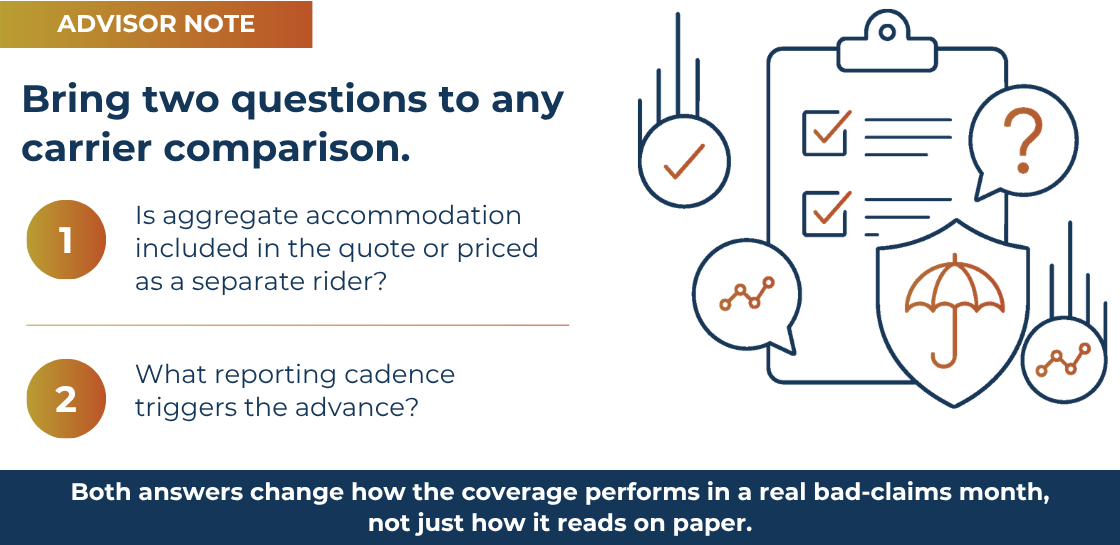
- Whether accommodation is included. Some carriers bundle it as standard, while others sell it as an add-on or leave it out of the base quote entirely.
- The reporting cadence. Confirm how often your claims data gets reviewed for accommodation eligibility, since a quarterly review works very differently from a monthly one in a fast-moving claims year.
- Where the trigger sits. Some policies release funds only once claims cross the full aggregate deductible, while others trigger at a percentage below it. That difference changes how early the relief arrives.
- How reconciliation works. Understand what happens to your advances at year end and whether any repayment obligation applies if your final claims come in lower than projected.
- Whether specific claims get the same treatment. Confirm that specific advance funding runs alongside aggregate accommodation, not in place of it, so both types of claim pressure are covered.
Where Aggregate Accommodation Fits in a Group Captive
Specific advance funding comes standard in every Roundstone captive placement at no additional cost. Aggregate accommodation is included with all policies covering fewer than 250 lives, though members can opt out. In that case, that employer would be responsible for overages.
That distinction is possible because of how the captive itself is built. Pooling risk and reserves across hundreds of member employers gives Roundstone the reserve depth to offer accommodation as standard, extending it to smaller employers that couldn’t absorb a rough claims quarter on their own balance sheet.
Still have questions about aggregate accommodation in stop-loss insurance? See Frequently Asked Questions below.
Learn More About Self-Funding with Roundstone
Aggregate accommodation is one line in a longer stop-loss proposal, but it’s the line that matters most in exactly the month you can least afford to wait on it. If you’re comparing self-funding options, talk with a Roundstone specialist about how aggregate accommodation and specific advance funding work inside a group captive built for employers your size.

Frequently Asked Questions
How does aggregate accommodation differ from aggregate stop loss?
Aggregate stop loss caps the total amount your plan owes for the year. Aggregate accommodation controls when you get reimbursed for the overage. One sets the ceiling on your liability, while the other manages the timing of the money that comes back once you approach it.
What happens if claims exceed the aggregate deductible before year end?
Your stop-loss carrier reimburses eligible claims above the deductible according to your policy terms. Without accommodation, that reimbursement typically arrives after year-end reconciliation. With accommodation, you can receive advances against that reimbursement as the deductible approaches rather than waiting for the full plan year to close.
Does aggregate accommodation cost extra?
Yes. Aggregate accommodation is an election, not a standard feature, at $2.00 PEPM (per employee per month). But specific advance funding comes standard in every Roundstone captive placement at no additional cost.
When does the accommodation advance get reconciled?
Aggregate accommodation advances get reconciled at the end of every policy year, against your actual aggregate reimbursement. That reconciliation is also what determines whether an audit is required.
Do smaller employers need aggregate accommodation?
Smaller employers often feel claims volatility more acutely, since a single bad month represents a larger share of their total claims budget. Accommodation gives these groups a cash flow buffer that larger, better-reserved employers may need less, which makes it a meaningful factor when comparing self-funding options.